Tips for Selecting a Preset or Adjustable Click Wrench

There are various “Preset” and “Adjustable” click wrenches, but selecting the correct industrial click wrench for your application depends on your process requirements. Preset click wrenches are ideal for production applications where consistent torque is critical. Adjustable click wrenches are suitable for fastening applications where quick torque setting adjustments are necessary for fasteners of different sizes.

Preset Click Wrenches

A preset click wrench is designed to ensure repeatable torque during the bolting process. The wrench improves productivity by consistently applying the correct torque value to each fastener. Preset click wrenches are ideal for fastening applications where operators repeatedly assemble parts at the same torque setting. A preset wrench is similar to setting an alarm clock to signal the achievement of a selected time. The wrench is preset to the application’s required torque value. The tool signals once torque is achieved, reassuring you with accurate and consistent results.

A preset click wrench doesn’t have an external torque adjustment scale. These tools have an internal torque adjustment mechanism for setting the torque value using an adjustment key and a torque analyzer. The locking mechanism prevents accidental torque setting changes. Once the tool is set, the wrench’s end cap is sealed with a calibration sticker and ready to use. However, if the preset torque value needs to be changed for a new fastening application, the flexible tool can easily be adjusted to a new preset torque value.

Adjustable Click Wrenches

An adjustable click wrench can save manufacturers and maintenance workers time and money by allowing them to accurately tighten critical fasteners of different sizes—all with a single tool. Thanks to these tools externally adjustable torque setting function, you can quickly switch torque values in the field or at the station, improving productivity. A quality adjustable clock has an easy adjustment process and a locking mechanism that prevents incidental torque adjustment.

Industrial Click Wrenches

Strong, robust, and reliable, Mountz click wrenches deliver the necessary power to tighten any bolt. More economical than other styles of torque wrenches, click wrenches can also handle far higher torque values.

The metal handle click wrenches are designed with durable all-steel construction and a corrosion-resistant finish and are suitable for various industries, such as aerospace, automotive, machinery, chemical, nuclear, energy, and other industrial environments.

Mountz EPT adjustable and IPT preset click wrenches feature a lightly knurled, non-slip grip. They are designed and manufactured to meet or exceed the accuracy and repeatability requirements of ISO6789:2003 and are suitable for medium and high torque applications.

Mountz click wrenches deliver reliable process control. To see our full range of products, shop our store. Contact us anytime to ask a question. To inquire about price, request a quote. If you’d like to see our equipment in person, schedule an appointment. To get the latest torque-related news, follow us on LinkedIn.

Guide for Selecting a Precision Torque Wrench to Improve Process Control

In any application where the fastening of bolts and screws is critical—which includes aerospace, automotive, medical device, electronics, and packaging industries, to name a few—businesses depend on torque tools to deliver the precise amount of force necessary to hold a fastener in place indefinitely.

Whether you’re in manufacturing or maintenance, the most important attributes your torque wrench should have are quality and reliability. The best way to be sure the wrench you’re investing in will hold up on the line is to choose the right torque wrench technology.

Applying the right amount of torque to each fastener maximizes its holding potential. When too much torque is applied, it can strip or crimp threads, damage the fastener, or harm the assembly. Under-tightening can cause a screw or bolt to work free under stress, vibration, and fall out.

Torque Wrench Mechanisms

In essence, all torque wrenches do the same thing: They apply a radial force to a fastener to tighten or loosen it. However, the torque wrench must have some mechanism to limit the amount of torque its operator applies. The type of torque-limiting mechanism is what separates different torque wrench technologies.

Each class of wrench relies on different torque limitation methods, and other techniques are most effective for various applications. Selecting the appropriate wrench is essential as it will determine the type of technology and budget invested for the fastening solution.

Click Wrenches

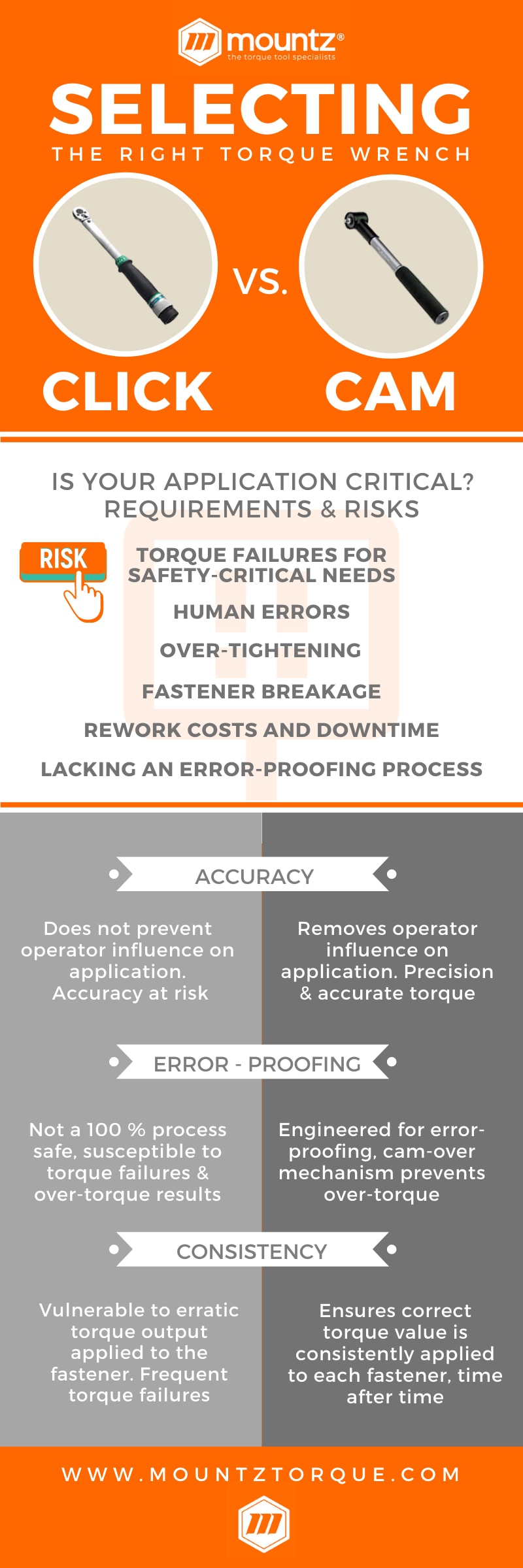
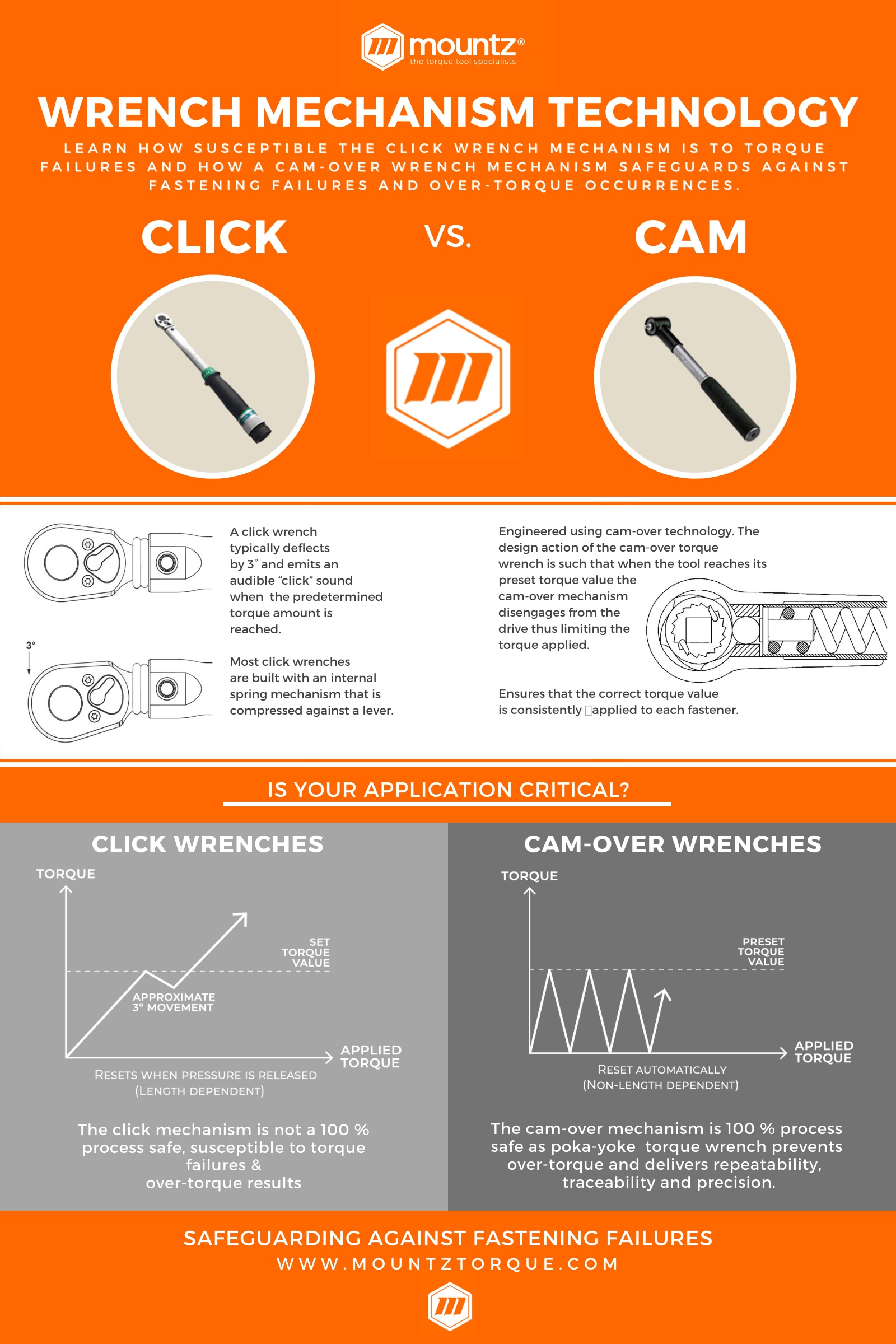
The most common type of torque wrench in the world, and the simplest, is the click wrench. Click wrenches are basic tools. A click wrench typically deflects by 3° and emits an audible “click” sound when the predetermined torque amount is reached. The click mechanism is not 100 % process safe as the wrench is easily susceptible to torque failures and over-torque results. Often an operator misses the “click” sound nor feels the click movement because a click wrench does not physically prevent an operator from applying additional force. They unknowingly generate over-torque.

Cam-Over Wrenches

The cam-over wrench, also known as the poka-yoke wrench, is a game-changer. It features cam-over technology that prevents over-torque. The wrench uses an internal cam-over mechanism to reduce the risk of operator error by disengaging once torque is achieved. This error-proofing wrench removes the operator’s influence on the torque equation, delivering an accurate and repeatable fastening result. Upgrading to a cam-over wrench ensures that any operator can deliver the correct torque, time after time, without the risk of over-torque.

Download White Paper: “Click vs Cam-Over Wrench Technology”

Learn the benefits of upgrading from a click wrench to a cam-over torque wrench, which physically prevents its operator from applying too much torque from this white paper.

What You Will Learn:

  • Why a click wrench cannot stop the operator from applying too much torque
  • Ways to test and confirm a click wrench over tightened a fastener
  • How cam-over technology prevents over-torque
  • Understanding the quality and productivity benefits of implementing a preset cam-over wrench
  • Making an error-proofing method seamless throughout the entire assembly process
  • How to ensure correct torque is consistently applied.

Safeguarding against fastening failures requires you to deploy a torque wrench designed to error-proof the assembly process. Whether you’re in manufacturing or maintenance, the most important attributes your torque wrench should have are quality and reliability. The best way to be sure the wrench you’re investing in will hold up on the line is to choose the right torque wrench technology.

Mountz cam-over torque wrenches are U.S. manufactured and engineered with Silicon Valley innovation and excellence. To see our full range of products, shop our store. Contact us anytime to ask a question. To inquire about price, request a quote. If you’d like to see our equipment in person, schedule an appointment. To get the latest torque-related news, follow us on LinkedIn.

3 Ways to Prevent Over-Torque Bolting Failures with Cam-Over Wrench

Implementing a solution that prevents over-torque events is critical for engineers to reduce scrap rate costs. Applying the right amount of torque to each fastener maximizes its holding potential. Over-torquing a fastener generates risks of fastening failures and damaged products.

Applying too much force while tightening a fastener can result in over-stretching a bolt, stripping a screw, breaking a screw head, or damaging the threads. The cam-over wrench’s mechanism design limits the torque an operator applies. This type of torque limiting mechanism is what separates different torque wrench technology. Cam-over wrench technology safeguards against fastening failures and enhances the reliability of the fastening process.

Click Wrenches

The most common type of torque wrench in the world, and the simplest, is the click wrench. A click wrench typically deflects by 3° and emits an audible “click” sound when the predetermined torque amount is reached. The click mechanism is not a 100 % process safe as the wrench is easily susceptible to torque failures. Often an operator misses the “click” sound nor feels the click movement. A click wrench does not physically prevent an operator from applying additional force. Fastening bolts with a click wrench expose manufacturers to a quality risk. The tool does not physically prevent an operator from applying additional force and is easily susceptible to over-torque results.

Cam-Over Wrenches

Engineered with a cam-over technology, the poka-yoke wrench prevents over-torque. The cam-over tool uses clutch mechanisms that prevent the operator from applying too much torque to the fastener, preventing over-torque events, broken components, costly product returns, and safety risks. Implementing this error-proofing wrench removes the operator’s influence out of the torque equation and delivers an accurate and repeatable fastening result than a standard click type wrench. 

From this webinar, you can learn three ways to prevent over-torque failures with cam-over wrench technology to improve manufacturing and productivity output.

What You Will Learn:

  • What type of torque wrenches are susceptible to over-torque events
  • How cam-over technology prevents over-torque occurrences
  • Discover the productivity benefits of a preset cam-over wrench
  • How to implement an error-proofing process
  • How to ensure correct torque is consistently applied.
  • Discover the quality differences between a click vs. cam-over wrench.

View Mountz torque webinar video 

Mountz cam-over torque wrenches are U.S. manufactured and engineered with Silicon Valley innovation and excellence. To see our full range of products, shop our store. Contact us anytime to ask a question. To inquire about price, request a quote. If you’d like to see our equipment in person, schedule an appointment. To get the latest torque-related news, follow us on LinkedIn.

How to Select a Precision Torque Wrench? Click vs. Cam-Over Wrench Technology

How do you select a precision torque wrench when comparing the technology and quality differences between a click wrench and a cam-over wrench? Each wrench mechanism design limits the amount of torque an operator applies. The type of torque limiting mechanism is what separates these wrenches in ensuring accuracy and precision.

Applying the correct torque to each fastener maximizes its holding potential. When too much torque is applied, it can strip or crimp threads, damage the fastener, or harm the assembly. Under-tightening can cause a screw or bolt to work free under stress, vibration, and fall out.

Click Wrenches

The most common type of torque wrench in the world, and the simplest, is the click wrench. Click wrenches are basic tools. A click wrench typically deflects by 3° and emits an audible “click” sound when the predetermined torque amount is reached. The click mechanism is not 100 % process safe as the wrench is easily susceptible to torque failures and over-torque results. Often an operator misses the “click” sound nor feels the click movement because a click wrench does not physically prevent an operator from applying additional force. They unknowingly generate over-torque.

Cam-Over Wrenches

The poka-yoke wrench features cam-over technology and prevents over-torque. The wrench uses an internal cam-over mechanism to reduce the risk of operator error by disengaging once torque is achieved. Implementing this error-proofing wrench removes the operator’s influence on the torque equation and delivers an accurate and repeatable fastening result than a standard click-type wrench. You can provide a cam-over wrench to any operator and be confident that they will deliver the correct torque, time after time.

 You can learn the benefits of upgrading from a click wrench to a cam-over torque wrench, which physically prevents its operator from applying too much torque from this webinar.

What You Will Learn:

  • Why a click wrench cannot stop the operator from applying too much torque
  • Ways to test and confirm a click wrench over tightened a fastener
  • How cam-over technology prevents over-torque
  • Understanding the quality and productivity benefits of implementing a preset cam-over wrench
  • Making an error-proofing method seamless throughout the entire assembly process
  • How to ensure correct torque is consistently applied.

View Mountz torque webinar video

Safeguarding against fastening failures requires you to deploy a torque wrench designed for error-proofing for the assembly process. Whether you’re in manufacturing or maintenance, the most important attributes your torque wrench should have are quality and reliability. And the best way to be sure the wrench you’re investing in will hold up on the line is to choose the right torque wrench technology.

Here’s your opportunity to learn how to make a business case for upgrading your click wrenches to cam-over wrenches.

Mountz preset torque wrenches are U.S. manufactured and engineered with Silicon Valley innovation and excellence. To see our full range of products, shop our store. Contact us anytime to ask a question. To inquire about price, request a quote. If you’d like to see our equipment in person, schedule an appointment. To get the latest torque-related news, follow us on LinkedIn.

Inch-Pound Torque Wrenches Tighten Small Fasteners and Produce Big Benefits

Archimedes famously said that given a long enough lever and a place to stand, he could move the world. Contrary to Archimedes’ expectations, much of the machinery that moves the world isn’t large but small. And for most, the challenge isn’t finding a large enough lever but rather one that is correctly sized and precise enough for our needs.

We depend on machinery and electronics to move our world, and this means using screws and bolts that are tightened with exactly the right amount of force to keep expensive parts and components safely together. Many of these fasteners are small and don’t require a large lever to turn them. Instead, they need a small inch-pound torque wrench with a torque control mechanism that prevents over-tightening and damage to fasteners, the mechanical housings they connect to, or the vital electronic components they hold in place.

What are Inch-Pound Torque Wrenches?

Torque is a measure of the amount of turning or twisting force applied. It is determined by multiplying the amount of force by the distance from which it is applied, with measures usually given in foot-pounds of torque. Inch-pound torque wrenches are simply torque wrenches that can deliver less than a single foot-pound of torque. They deliver force that can be measured in a fraction of inch-pounds or in inch-ounces.

Not surprisingly, the fasteners that require such fractional measures of force tend to be smaller. However, just because these fasteners are smaller doesn’t mean it is any less important to ensure proper torque control. Examples of fasteners with torque measured in lbf.in or ozf.in include brake system bolts, fittings for hydraulic or gas lines, and the screws that hold hard drive cases together. For these fasteners, it is important to not only choose an inch-pound torque wrench that can provide exactly the right amount of force but also one with a torque control mechanism that actively prevents you from exceeding the torque limit and damaging the fastener or the components.

Types of Torque Control Mechanisms for Torque Tools

Hand torque tools include torque delivery mechanisms that either warn the operator if they are at the torque limit or physically stop them from exceeding it. The types of torque control mechanisms are listed below:

  • Click Wrenches: These tools make an audible clicking noise when the torque limit is reached. The handle also deflects slightly to provide tactile feedback that it’s time to stop turning the wrench. However, the force is not actively disengaged from the fastener, so it is possible to apply too much torque. As such, click wrenches are best for non-critical applications.
  • Break-Over Wrenches: Breaking over means that when the torque limit is reached, a joint between the head and the shaft “breaks” and the handle deflects by anywhere from 20° to 90.° The user knows the fastener is tightened to the correct torque specification and the break-over prevents them from exceeding specifications.
  • Cam-Over Wrenches: A clutch disengages the head from the shaft when the torque limit is reached. Once a fastener reaches the set limit, the wrench slips around the fastener without applying more force. Cam-over wrenches and cam-over torque screwdrivers are both available.

When it comes to inch-pound torque wrenches, there are many options. You can find adjustable click wrenches that apply inch-pounds of force and have graduated scales in inches or half-inches. This way, the user can select the precise torque setting they need. These wrenches are effective for relatively robust applications such as braking systems or industrial equipment. Remember, though, the click is a warning and not an active preventive measure. More sensitive equipment might require more stringent torque control measures.

For industries whose products are sensitive to over-torquing, consider an inch-pound torque wrench with a break-over mechanism. You can set these tools for a lower amount of torque than many click or cam-over wrenches, with settings in the single digits of lbf.in, a few dozen ozf.in, or even a single ozf.in. These low torque settings, coupled with the ability to physically prevent over-tightening, make break-over wrenches ideal for applications such as commercial refrigeration repair or assembling coolant lines made of soft non-ferrous metal.

In the electronics industry, most fasteners are screws, and cam-over torque screwdrivers can tighten screws to the right level without causing damage to the plastic and other materials used in electronic components and housings. Pre-set torque screwdrivers are available in settings as low as 5.7ozf.in, and their pre-set nature makes them ideal for use on assembly lines where each station must drive many screws to exactly the same standard. Adjustable torque screwdrivers can be set as low as 10 ozf.in of torque and as high as 80 lbf.in, allowing for a great deal of flexibility. Dial torque screwdrivers can be used to check everything that is coming off an assembly line to ensure that there are no errors.

High-quality inch-pound torque wrenches and screwdrivers keep the world moving better than any large hypothetical lever. In the modern world, where big things can come in pocket-sized packages, the smallest fasteners often hold the most critical elements. Inch-pound torque wrenches make sure that these fasteners are tightened exactly to spec and will hold for the long-term.

Mountz Inc. understands how important small fasteners are to the big picture. That’s why we’re committed to making the best inch-pound torque wrenches and screwdrivers for our customers. To see our full range of products, browse our catalog. Contact us anytime to ask a question. To inquire about price, request a quote. If you’d like to see our equipment in person, schedule an appointment.

Maintaining Forklift Maintenance Safety Standards with Precision Torque Tools

Nearly everything we eat, wear, or place in our homes moves on a pallet. Lifting those pallets are ANSI B56.1-1969 standard powered industrial trucks—better known as forklifts. If you buy a product in a store, it has been moved by a forklift at some point. The everyday operation of warehouses, distribution centers, and, indeed, the entire supply chain depend on these humble vehicles. Even if a warehouse has multiple forklifts, the loss of even one for a single day can seriously impact warehouse productivity and even cause contract violations due to missed deliveries.

OSHA takes forklift maintenance seriously, with three different sections concerning forklift maintenance. In order to perform safe, reliable repairs that comply with manufacturer’s specifications and OSHA standards, you need precision torque tools that can tighten every bolt, screw, and hydraulic fitting with exactly the right force needed to hold a part securely in place without damaging the fastener or the part.

Why Torque Tools are Vital for Hydraulic Systems

The type of relatively small forklift you see in your average warehouse has some serious might, capable of lifting 4,000 to 5,000 pounds. The forklift can carry this weight across the warehouse at approximately 10 miles an hour and can lift it 12 feet overhead. With extensions to its mast, it can lift pallets even higher into high rack systems. Or, with additional counterweights, it can carry even more. All this adds up to extraordinary stress being placed on the bolts holding a forklift together, and it highlights the dangers of having any part of a forklift fail in your warehouse. In order to prevent such hazards, your fasteners and hydraulic fittings must be adjusted to the manufacturer’s specifications, and this is given in the measure of torque.

Torque is the measure of the radial force applied to the fastener as it is screwed in. Apply too little torque to a fastener and it will not stay fastened in place. In forklift maintenance, a hydraulic fitting that is too loose may not be able to hold the pressure of the fluid in the line when the forklift picks up a pallet, resulting in leaks. Hydraulics depend on the pressure of this fluid pushing off of pistons in order to work, and a forklift with a loose hydraulic fitting can have its loaded forks drop very quickly.

Over-tightening one of these fittings is no better than leaving it loose, as they’re often made of soft, non-ferrous metals. Applying too much torque damages the threads so that they will not seal or so that the fitting can pop under loads. In either case, the likely consequences are a dropped pallet, a spray of hazardous hydraulic fluid—which, on top of everything else, can be scalding hot—and significant delays in operations as the mess is cleaned up and a repair or replacement for the forklift is found.

That is the best case scenario. If someone is injured by the falling pallet or a spray of hydraulic fluid, then operations may be stopped entirely for a thorough investigation and review of your warehouse practices. Proper maintenance of hydraulics using torque tools, therefore, is necessary to avoid such harmful accidents.

Engine Repair Requires Torque Tools

If you’ve done mechanical repair of any type, you probably have encountered an incorrectly torqued fastener. Usually over-torqued, these bolts or screws can be easily recognized by their refusal to turn even as you stand on the wrench and the way their heads round off. Their shanks also have been known to snap, leaving the head of the fastener in your hand and most of the shaft still in the bore with no easy way to turn it. Often, repairs are held up for hours while workers either carefully loosen these fasteners or extract them after they break.

Many forklifts are powered by internal combustion engines similar to cars, and, as in an automobile, forklift engines have torque specifications for the bolts used for the water pump, crankshaft, camshaft, cylinder heads, and every part of the engine inside and out. In the case of crankshaft bearing bolts and connecting rod bolts, there are two specifications: one each for the first and second tightening passes. Tightening by feel and having it too loose can cause a bolt to come free inside the engine and destroy the engine block. If they are over-torqued, the bolt can shear under the force, also destroying the engine block.

Over- or under-tightening even seemingly less critical parts can also have catastrophic consequences. For instance, if the bolts that hold the water pump to the exterior of the block are not tightened correctly, then coolant leaks can ruin the engine. This is to say nothing of the problems you might encounter if pulley torque specifications aren’t correct. Engine work, whether it is for forklift maintenance or repair, needs to be done to spec in order to keep everything functioning reliably.

The Best Tools for Safe Forklift Maintenance

Forklift maintenance uses a variety of fasteners set to different torque specifications. Hydraulic fittings are made of softer metals sensitive to over-torquing. For these applications, it’s best to use tools that actually prevent over-tightening by disengaging once the set threshold is reached. Cam-over and break-over torque wrenches both meet this requirement. Cam-over wrenches disengage at the set limit and stop turning the fastener. Break-over wrenches disengage the handle from the head. Due to the variety of fasteners and different torque settings found on forklift hydraulics, an adjustable break-over wrench with interchangeable heads is the best tool to use. It will work well for many fasteners found in forklift mechanical systems, too.

The bolts that go onto a forklift’s engines tend to be made of sterner materials like steel, so they aren’t as vulnerable to over-tightening. They generally need to be tightened with more force to hold, and this might not be possible with the wrench you might use for hydraulics. Click wrenches have higher maximum torque settings than other wrenches. However, these audibly warn the user with a click when they’re approaching the torque limit instead of disengaging. Since they don’t actively prevent the operator from exceeding limits, they should be used with care and attentiveness.

Everything in the modern supply chain depends on forklifts to make it into the hands of consumers. Manufacturing centers also rely on these vehicles to function daily. In order to stay in operation, meet contractual agreements, and provide the inventory you need to stay in business, forklift maintenance needs to be done to specifications using the right torque tools.

Mountz, Inc., knows the importance of doing a job right, whether it’s preventative maintenance or a complete engine rebuild, and we provide the tools to get the job done every time. To see our full range of products, browse our catalog. Contact us anytime to ask a question. To inquire about price, request a quote. If you’d like to see our equipment in person, schedule an appointment.

Why Commercial Refrigeration Repairs Require Top Torque Tools

In refrigeration, you don’t actually cool a room, refrigerator, or freezer. Instead, you pump the heat out, and doing so requires an arrangement of tubing, blowers, compressors, and evaporators all connected with fittings. If a fitting is left loose, a service valve cap might leak, releasing its refrigerant. If you tighten it too much, you may strip the threads off, not only creating a leak but also making it necessary to cut the valve free and braze a new one on. In private homes, a loose or damaged service valve causes discomfort. In a commercial freezer, this broken valve means the loss of months worth of perishable food. In a hospital, it creates a shortage of lifesaving vaccines and medicines.

Commercial refrigeration repair demands precision. Tightening a service valve, mini-split, or flare nut by hand and giving it a quarter turn just doesn’t cut it. Whether they’re being done by do-it-yourselfers or pros, commercial refrigeration repairs should be completed using precision torque tools.

Constant Vibration Demands Fittings Tightened to Spec

The sound of the evaporator fan, condenser fan, and condenser motor are familiar, comforting noises in our homes. What it means, though, is continual vibrations as the fans spin up and the motors springs to life. These vibrations can loosen fittings on a commercial cooling unit, refrigerator, and even a home’s air conditioner. Once loosened, the refrigerant can start leaking out, and once it’s gone, the blowers do about as much to cool the interior space as a lazily spinning desk fan would. In order to remain tightly in place, refrigerant fitting and machinery parts must be joined with fasteners tightened to the correct level of torque.

Torque is radial force. It is measured in foot-pounds (lbf.ft) and is the amount of force multiplied by the distance from its point of application. In other words, when you slide your hand farther back on a wrench to turn a stubborn bolt, you’re increasing the amount of torque, and you can damage a condenser motor, fans, fittings, or their housings if you do not apply the correct amount. Turning a threaded fitting compresses the threads so that they clamp down and stay in place. Apply too little force and the vibrations of the motor will eventually cause a fitting to become loose. The fans and motors will wobble as they work if the same thing happens with a screw holding them in place. On the other hand, if you exert too much force—and too much torque—when doing commercial refrigeration repairs, you’ll likely create several new problems.  

Softer Metals Require a Precisely Measured Softer Touch

Refrigerant tubing is made of copper, and that makes it especially important to use a precise amount of torque. Over-tightening a valve cover or a flare nut trying to be sure you have a tight seal can not only strip out the threads and compromise the seal but also kink the line or break it. When this happens, the only choice is to cut the tubing back, braze a new joint onto it, and try again with a new fitting—a process that takes a significant amount of time. It’s better to install fittings with the correct amount of force precisely measured.

Due to their amazing ability to transfer heat, condensers in commercial refrigerators are often made of aluminum. This too is a softer metal and in condensers, it is especially thin. Mounting it to a frame or rear housing made of steel or stainless requires precise control over the amount of force exerted on the steel bolts or screws holding it in place. Driving the fasteners too hard and too deep can punch their heads through thin aluminum mounts. In the best case scenario, the condenser is then missing a fastener which may lead to issues with vibration later on. In the worst case scenario, you could damage the condenser so it’s unusable by twisting it or bending a large part of it.

Choosing the Best Torque Tools for Commercial Refrigeration Repair

Using quality torque tools is the best way to ensure commercial refrigeration repairs are done correctly. Torque wrenches and torque screwdrivers prevent over-tightening by either warning their user or disengaging when they reach a threshold of force. Breakover wrenches disengage the hinge between the wrench head and the handle when the correct torque is reached, preventing over-torquing. Since they physically prevent the operator from applying too much torque, these tools work well for installing compression fittings, flare nuts, valves, and valve caps to easily twisted refrigerant tubing. They also work well for tightening a bolt on a compressor mount. A click wrench, which warns the user when they’re close to the force limit but does not physically stop the user from exceeding it, can also be a good choice. Click wrenches deliver very high torque values, so they may be the ideal tool for large commercial refrigerators that cool or freeze food storage warehouses.

For the lighter work of mounting condensers and tubing to refrigerators and air handlers, adjustable torque screwdrivers work best. These can be set to the precise specifications of the refrigeration system model being repaired, and the tips can be swapped out to match different fasteners. The variety of fasteners that are used for this purpose may call for a full screwdriver kit with sockets and driver heads that fit any fastener encountered in the field.

A lot depends on commercial refrigeration repairs. Refrigeration doesn’t just ensure our comfort; it ensures that we have safe food to eat and effective medicines. Consulting refrigeration equipment torque specification sheets and having the tools on hand to precisely comply with those specifications ensures that commercial refrigeration repairs go smoothly. That way, both pro and DIY refrigeration technicians can keep their cool and keep their work cold.

At Mountz Inc. we understand the importance of refrigeration repair, ensuring that food arrives safe to eat and that a cold drink is ready at the end of the day. To see our full range of products, browse our catalog. Contact us anytime to ask a question. To inquire about price, request a quote. If you’d like to see our equipment in person, schedule an appointment.

Snow Vehicle Maintenance Demands Efficient Torque Control

For some areas in the United States, winter isn’t the end of the year; winter is the year. Winter is when the ponds ice over for fishing, the falls freeze for climbing, and the snow covers the ground for skiing. It’s when the hockey sticks come out of the closet, the snowshoes get tightened, and the cider and eggnog come out of the fridge. In some regions, it isn’t until winter that the roads are even solid enough to drive over.

But while winter can be a lot of fun, it’s also a highly demanding season. Especially in the northern parts of the country—like Maine, Minnesota, Montana, and Alaska—the work doesn’t stop when the snow starts to fall. Nights are long, temperatures are low, and if your vehicle breaks down, you’ll be wishing you had stayed indoors by the fire. So, whether you’re prepping up your favorite two-stroke for a backcountry patrol or tuning up the treads on your yard’s PistenBully, it’s important to take into account that effective snow vehicle maintenance requires efficient torque control.

Torque Control for Snow Vehicles

There is a broad range of snow vehicles used professionally and recreationally across the United States, and they require maintenance every year in order to ensure safety. Light, medium, and heavy snow vehicles—like snowmobiles, snow groomers, and tractors—all demand just as much care as regular land vehicles of their size. Whether these high-performance vehicles are traveling at high speeds or hauling heavy loads, they’re subject to significant, sudden amounts of stress during normal operations. The fasteners in these vehicles, which hold skids to the frames and tracks on their axles, must be torqued properly to prevent breakdowns and failures in the field.

Given the intense conditions snow vehicles operate under—exposure to freezing temperatures, vibration, heavy friction, and the demands of uneven terrain—it’s no surprise that even the toughest machines can wear down fast if not properly maintained. Whether it’s a snow groomer prepping trails or a heavy-duty utility tractor pushing through drifts, the performance and safety of these vehicles hinge on timely inspections and expert repairs. Attention to drivetrain components, hydraulic systems, and especially torque settings on critical fasteners is essential to avoid costly downtime or dangerous failures. It’s in this kind of demanding environment that the expertise of Rush Diesel makes a noticeable difference.

With a deep understanding of how stress impacts both diesel and heavy-duty machinery, they offer maintenance services that go beyond routine checks—diagnosing hard-to-find issues, reinforcing structural integrity, and ensuring every system performs at its peak. For operators who rely on their equipment no matter the weather, having trusted technicians who treat vehicle longevity as seriously as performance isn’t just helpful—it’s vital.

Torque is the amount of radial force. Applied to a fastener, it’s what makes a screw turn. The turning of a screw compresses its threads so that they clamp down and hold onto the substrate material. So, basically, torque is what holds screws in place. Apply too much, and the screw or the material it’s holding together can warp, strip, or deform. Apply too little, and the fastener can rattle loose and fall out, or it can shear. If it falls out in the snow, chances are you’re never going to find it.

Losing a screw may be the least of your worries if a critical component of your snow vehicle’s engine, transmission, or carriage breaks down due to improper maintenance. If your vehicle is in the yard, grooming a runway or hauling containers, it may mean scheduling delays as the vehicle goes down for maintenance. If you’re in the backcountry, it could mean you’re miles from help in subzero temperatures and shifting visibility. Whether or not you intend to personally use the snow vehicles you maintain, it’s important to realize that errors can create costly, if not life-threatening, situations.
That’s why preventative care and timely repairs are more than just best practices—they’re essential to keeping your diesel-powered snow vehicles ready for whatever terrain and temperature lie ahead. From inspecting fuel systems and glow plugs to diagnosing hidden engine wear, diesel maintenance plays a critical role in ensuring that breakdowns don’t turn into emergencies. Routine service can mean the difference between getting the job done and getting stranded.
When you need diesel repairs done right, it helps to have experts who understand the demands of rugged equipment and harsh environments. G&R Diesel brings that level of precision to every job, offering diagnostics, repairs, and rebuilds tailored to heavy-duty diesel engines. Whether you’re hauling gear across frozen terrain or managing a fleet from the shop floor, their team helps ensure your equipment doesn’t just survive the season—it conquers it.

But even the most well-maintained diesel engines and snow vehicles can come to a standstill if something as seemingly minor as a lost or damaged key gets in the way. When your equipment is critical to day-to-day operations, being sidelined by a key issue isn’t just frustrating—it’s costly. Whether it’s a utility vehicle needed for runway clearing or a specialized snow rig supporting remote logistics, access matters. That’s why services like those provided by http://goldcoastcarkeys.net.au are invaluable for operators who can’t afford downtime. Their expertise in replacing, programming, and repairing keys for a wide range of vehicles ensures that you’re never stuck waiting in the cold for access to essential gear. In high-stakes environments where every minute counts, having reliable solutions for every link in the chain—yes, even your keys—can make all the difference.

Changing Temperatures Require Continual Snow Vehicle Maintenance

The matter of applying proper torque to fasteners in snow vehicles is made more pressing due to changing temperatures. Plastics and metals, the primary substrate materials in snowmobiles and other snow vehicles, expand and contract as they are heated and cooled. If your vehicle is parked overnight in a heated garage or similar area, then every time it’s parked, all the materials will expand. Then, when it’s taken outside and used, the materials will contract again. That’s in addition to the regular shrinking and swelling that occurs when warming up a hot motor on a cold day.

Screws and bolts will be worked loose by the expansion and contraction cycle faster than they would be in stable temperatures. For maintenance workers, this means that snow vehicles require more frequent checks to make sure the fasteners are holding. Each time a fastener is found to be too loose or too tight, it must be adjusted to return to its proper torque value.

Choosing Torque Tools for Snow Vehicle Maintenance

Torque tools are the best way to be sure that you or mechanics under your watch apply the right amount of force to each screw and bolt. Torque tools prevent their operators from applying more force than intended, either by warning them or by physically preventing them by “breaking” or disengaging their clutch. Both hand tools and power tools can be effective for snow vehicle maintenance.

For many fasteners on snow vehicles, hand wrenches—like click wrenches and cam-over wrenches—can get the job done right. Click wrenches can deliver very high torque values and are the least expensive type of hand torque wrench. However, since they warn their operator of over-torque but don’t physically prevent it, they should be avoided for truly critical fasteners.

Break-over wrenches provide more specificity than click wrenches. These wrenches “break” on a hinge when the right amount of torque has been applied, preventing operators from over-torquing before the wrench is reset. Cam-over wrenches, however, are the gold standard for torque control. Their internal clutch mechanism slips when torque is reached, completely removing the possibility of applying too much torque.

If you’re working in a garage or shop with air compressors and electricity, certain power options will speed up your snow vehicle maintenance without sacrificing precision. Continuous drive pneumatic wrenches can apply a moderate amount of torque rapidly, and they slip to prevent over-torque conditions. Pulse tools can apply a higher amount of torque through a series of sharp, fast pulses on the head of a fastener.

Often, when we think of snowmobiling, we think of fun, freedom, and the exhilaration of a high wind on a cold day. But in order to enjoy the feeling of a fast ride over an open field or to get the runway open in time for the first cargo shipments, ensuring proper maintenance with appropriate torque tools is essential.

At Mountz Inc., we provide torque tools tough enough for even the coldest winters. Whether you’re maintaining racing performance snowmobiles or heavy-duty tractors, our tools have the power and specificity you need. To see our full range of torque tools, browse our catalog. Contact us anytime to ask a question. To inquire about price, request a quote. If you’d like to see our equipment in person, schedule an appointment.

New Torque Wrench Tester by Mountz Wins Industry Innovation Award

Mountz Inc., a specialist in providing torque and fastening solutions, today announced that it has been honored with a Pro Tool Innovation Award for its Validator torque wrench tester in the Test & Measurement –  Inspection category. Tool, fastener, and accessory winners were decided by innovation-including a mix of new features, power, and value. These are best-in-class products that are truly ahead of their time. Over 50 different manufacturers submitted 260 tool entries in dozens of categories for a shot to win a 2017 Pro Tool Innovation Award.

This is the third time in the past five years that Mountz has earned the innovation award. The patented MountzPro true dual click wrench won the award back in 2013 and the EPT adjustable torque wrench was selected in 2015. “This industry award reinforces the value Mountz provides to its customer base, enabling technicians and mechanics to quickly verify the calibration status of a torque wrench,” said Daniel Andeel, Vice President of Sales & Marketing.

“When manufacturers built tools and accessories that break the mold, they deserve recognition. Professional consumers need to know which tools are a cut-above and breaking new ground,” said Clint DeBoer, Executive Director of the Pro Tool Innovation Awards. “These are the tools that should really be in every tradesman’s toolbox. They can save you time, money, and even make the job easier or more ergonomic.”

A panel of judges made up of tool and media professionals from across the United States and Canada weighed in on entries from top global manufacturers, and Mountz, Inc. received an award for the Validator torque wrench tester.  Here’s what the judges had to say about the torque tester: “It’s the Guru on the mountain that can tell if your torque wrench is still within calibration limits. By taking care of torque wrench calibration checks in-house, you eliminate unnecessary servicing, keeping your crew more productive and the shop more profitable. Thanks to the easy Green/Red visual indicator, there’s no guesswork involved.”

The Validator allows for instant verification that a wrench is still in calibration. Coupled with a torque wrench management and maintenance program the Validator can provide significant cost savings by not relying on a time-based calibration interval but by servicing a wrench only when the wrench starts displaying the incorrect torque during in-house testing.

By performing periodic validations with a torque wrench a technician can be confident that the tool is producing accurately the desired torque setting. Periodic checks can be accomplished quickly with the use of our special Pass / Fail visual feedback system. A preset a target torque and tolerance are programmed and if a torque reading falls within the tolerance a Green light is illuminated, Pass. A Red light is illuminated for any out of tolerance readings, Fail. The operator only needs to look at the lights. The robust torque tester is ideal for field service, maintenance and production applications.

Using a quality torque measurement equipment makes a safer world through accuracy and precision. Controlling torque is essential for companies to ensure their product’s quality, safety and reliability isn’t compromised. The failure of a three-cent fastener that isn’t properly tightened can lead to catastrophic or latent failures. Fasteners that are insufficiently fastened can vibrate loose and excessive torque can strip threaded fasteners.


Aviation Click Wrench Selected for Helicopter Maintenance

Aviation Click Wrench

Across the world, twelve ton jets ascend to our skies hourly transporting our colleagues, our friends and our families. Helicopters maneuver the skies to provide traffic reports, medical evacuations, rescue operations and tourist excursions. Safety is key for any helicopter and airplane that fly across the skies. At the forefront of ensuring aircraft safety is maintained are aircraft mechanics that perform routine safety checks and maintenance programs.

Since helicopters have a lot of moving parts as compared to airplanes, there are more parts that could potentially malfunction. A helicopter has key parts that are in constant motion like gearboxes and rotors. Parts tend to wear out more quickly.

Maverick Helicopters is a tourism-based aviation company located in Las Vegas, along with additional operations in Henderson (Nevada), the Grand Canyon and Maui. Plus a new location in Kaui. The company currently has over 40 helicopters and a few fixed wing aircraft. Maverick Helicopters flies passengers around these beautiful destinations. The company has the top safety record of any tourism-based aviation company in the world and an ongoing commitment to safety.

Since Maverick’s helicopters are deemed as “aircraft for hire” service, the FAA requires the aircraft to be disassembled and inspected every 150 hours of flight time. The amount of flight time determines the level of disassembly, cleaning, inspection and reassembly required. Many of the parts on these helicopters are “service life limited,” which means after a helicopter achieves a certain amount of flight hours, the parts are discarded, regardless of its condition.

Every single bolt, nut and screw on these helicopters has a torque value. There are literally thousands of bolts and nuts. Every bolt and nut is torqued, and then a safety wire or cotter pin is placed. To apply torque to a bolt, the process requires three people. One mechanic sets the torque value on the click wrench and then the wrench is shown to the second mechanic. The second mechanic verifies the torque value is correct and then has to physically watch the wrench “click” and stays there until it is safety wired or cotter pinned. The third mechanic inspects the finished part that was completed. A simple mistake by one of the mechanics would be catastrophic. Every mechanic that works on the helicopter has to be a FAA licensed airframe and power plant mechanic with a helicopter certificate.

Maverick Helicopters uses the award winning EPT click wrenches by Mountz during the routine maintenance processes of servicing their helicopters. The EPT is an adjustable click wrench that provides different setting options for applications that require more than one torque value. The adjustable wrench features an external adjustment torque scale, which allows an operator to adjust the torque setting on the tool as needed. The EPT wrench offers an easy-to-read dual scale system (American & S.I.) with a laser marked scale along the body tube section of the wrench. Designed with durable all-steel construction and a corrosion-resistant finish, these metal handle click wrenches are suitable for various maintenance and assembly torque applications.

“All helicopter service stations need Mountz wrenches instead of using either Snap On or Matco wrenches, which are inferior quality and triple the price.” said David Burgess, Mechanic Technician, of Maverick Helicopters. “Our torque range is from about 31 inch pounds up to about 1100 inch pounds, on some of the bigger bolts on the main rotor. The Mountz torque wrenches are working great and everyone is very happy with them.”

Using a quality torque wrench makes a safer world through accuracy and precision. Controlling torque is essential for companies to ensure their product’s quality, safety and reliability isn’t compromised. The failure of a three-cent fastener that isn’t properly tightened can lead to catastrophic or latent failures. Fasteners that are insufficiently fastened can vibrate loose and excessive torque can strip threaded fasteners.

Need assistance selecting the correct click wrench? Contact us and we’ll be happy to help you find the perfect wrench for any fastening application.